Q&A platforms for SEO are widely underestimated in 2026. And most marketers stopped taking them seriously.
They don’t send much referral traffic. Most links are nofollow. And they rarely show up in backlink reports.
So they must be useless for rankings… right? Not even close. Q&A platforms haven’t lost value. They’ve just changed roles.
In 2026, they don’t pass link equity. They build real connections and reinforce topical authority. And they quietly shape how AI-driven search systems interpret your brand.
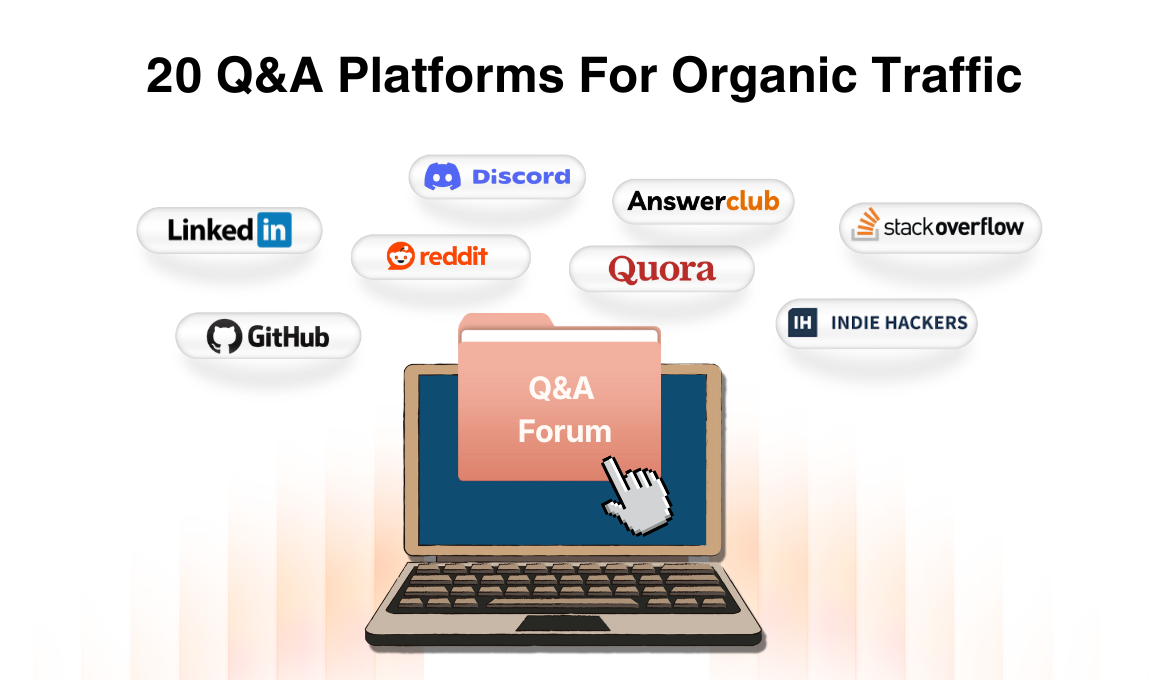
This guide breaks down 20 Q&A platforms that still matter — which ones strengthen authority, which ones are neutral, and which ones can slowly hurt your site if used carelessly.
Do Q&A Platforms Still Work for SEO in 2026?
Yes but not as traditional backlink sources.
Most Q&A backlinks are nofollow. That hasn’t changed. What has changed is how search systems interpret repeated presence and association.
In SEO in 2026, Q&A platforms help by:
- Reinforcing topical authority
- Associating your brand with specific problems and explanations
- Feeding language and context into AI-generated summaries
- Supporting long-tail and exploratory search visibility
They are not traffic drivers nor are they for quick wins. They are slow credibility builders.
How Q&A Platforms Help SEO in 2026 (Why They Still Rank)
Q&A platforms still rank because they reflect how people actually ask questions.
Real queries are messy. They mix uncertainty, assumptions, and partial understanding. Answers don’t agree cleanly. They explain trade-offs, exceptions, and edge cases. That kind of content is hard to fake and costly to automate well.
Search systems trust this format because it captures intent as it exists, not as marketers format it.
Google and AI systems continue to surface Q&A pages because they:
- match real search intent
- explain reasoning instead of conclusions
- show multiple perspectives around the same problem
AI-driven search systems tend to favor explanatory formats, and Q&A content naturally fits that structure.
That’s why Q&A platforms for SEO still appear in long-tail results, featured snippets, and AI summaries — even when links are nofollow. Their value is association and reuse, not link equity.
20 Best Q&A Platforms for SEO and Backlinks in 2026
If you’re expecting Q&A platforms to behave like classic backlink sources in 2026, you’re already misaligned.
Think of them less like “link assets” and more like reputation builders. Some platforms amplify you quietly while some bury you. And some do nothing unless you stay long enough.
1. Quora
Quora is one of the most used forums. Its strength isn’t links; it’s visibility. When Quora answers start appearing in AI summaries, it’s usually because they explain things cleanly without trying to sell. If you show up here consistently, your brand becomes part of how a topic is explained.
2. Reddit
Reddit is not friendly to marketers, and that’s exactly why it matters. If your brand keeps coming up naturally across threads, Google notices. AI systems do too. Reddit is less a backlink source and more a credibility stress test.
3. AnswerClub
AnswerClub is a smaller Q&A platform with lower competition and doesn’t need karma points to post. Answers don’t drown immediately, and contextual links survive longer. For emerging sites, this platform often punches above its weight simply because there’s less noise.
4. Stack Overflow
Stack Overflow is not where you promote. It’s where you prove you know what you’re talking about. A single good answer here can carry more authority than ten generic backlinks. Links exist, but the real value is association with correctness.
5. Stack Exchange Network
The wider Stack Exchange network behaves like an archive that people still trust. Content doesn’t spike. It settles. And that stability is valuable when you’re trying to anchor authority around a subject.
6. GitHub Discussions
GitHub Discussions sit close to real usage. People talk about what breaks, what works, and why. That practical language travels well into AI systems and technical search results. It’s less polished, more believable.
7. Hacker News
Hacker News is where ideas get weighed, not celebrated. Brand mentions here don’t convert fast, but they echo. If something survives scrutiny on Hacker News, it tends to reappear elsewhere.
8. Medium (Q&A-style posts)
Medium works when you resist the urge to ramble. Posts framed as answers tend to index well and reinforce topical association. Treat it like an explanation channel, not a blog dump.
9. LinkedIn Q&A and Comments
LinkedIn isn’t obvious, but it’s powerful in B2B contexts. Comments answering real questions often surface in search. Authority here is less about links and more about who is seen answering.
10. Product Hunt Discussions
Product Hunt discussions happen when users are already comparing tools. Mentions here feel earned. That timing matters more than raw authority.
11. Spiceworks Community
Spiceworks is slow, detailed, and trusted. For IT and enterprise topics, answers here age well and continue to surface for long-tail queries.
12. Webmasters Stack Exchange
This is one of the few places where SEO discussions stay technical instead of speculative. That clarity makes the content durable.
13. GrowthHackers
GrowthHackers rewards experience over theory. Brands that participate thoughtfully tend to get associated with practical growth, not hype.
14. Indie Hackers
Indie Hackers reads like a journal of what actually worked. That honesty makes it easy for AI systems to reuse and summarize.
15. Quora Spaces
Quora Spaces work when you think in clusters. Over time, they help reinforce what your brand is about rather than what it links to.
16. Slashdot
Slashdot is old, but age isn’t a weakness here. It still signals technical credibility in narrow circles, which is often enough.
17. Public Discord Forums (Indexed)
Indexed Discord forums feel like early signals. Not polished, not stable, but alive. Brand mentions here often precede wider visibility.
18. Public Facebook Groups (Indexed)
Public groups surface real questions and real frustration. That authenticity feeds local and niche SEO in ways polished content can’t.
19. AnswerThePublic (Community Answers)
AnswerThePublic helps you hear how people phrase uncertainty. That insight shapes better answers elsewhere.
20. Niche Industry Forums
Small forums are like small towns. Everyone notices who keeps showing up. That relevance often translates into the strongest contextual signals.
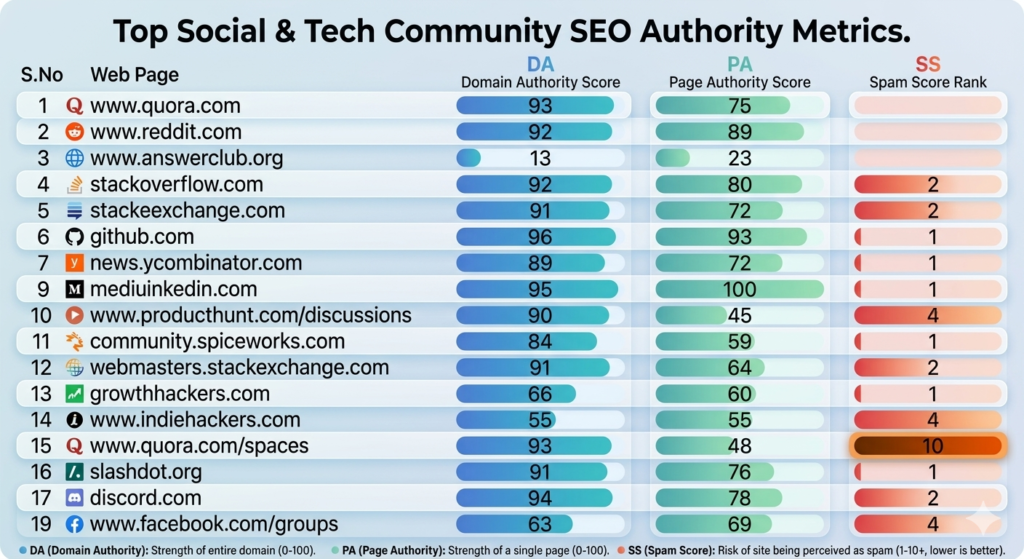
These metrics are included for reference only. Domain Authority and Page Authority don’t determine whether a Q&A platform helps SEO in 2026. Lower-authority platforms often outperform larger ones when answers stay visible longer and context is stronger.
Should New or Low-Authority Sites Use Q&A Platforms in 2026?
Yes but selectively. Q&A platforms won’t drive traffic or create fast ranking gains for new sites. They also won’t compensate for weak on-site content.
Where they help is early visibility and topical association.
Low-authority sites perform best on platforms where:
- answers don’t disappear immediately
- competition is lower
- moderation is lighter
- context matters more than credentials
That usually means starting with smaller Q&A communities, niche forums, and select mid-authority platforms. Highly moderated spaces like Reddit or Stack Overflow are valuable later, but difficult entry points early on.
For new sites, Q&A platforms are better used for learning and visibility than for authority building.
Q&A Platforms That Hurt SEO in 2026
Not all Q&A platforms contribute positively to SEO.
Auto-generated Q&A sites are the clearest example. They look active, but the content feels recycled. Answers follow the same patterns, reuse the same phrasing, and avoid real disagreement. Search systems detect this quickly. These platforms don’t build authority; they dilute it.
Link-drop communities are even riskier. Their only function is passing links, not solving problems. Many disappear quietly after deindexing or manual penalties. The links vanish, but the association remains. Any short-term gain rarely justifies the long-term risk.
How to Use Q&A Platforms Without Burning Time
Answers need to stand on their own. If an answer isn’t useful without a link, it won’t age well with one.
Brand mentions tend to survive longer than keyword anchors, especially when the same name appears repeatedly across related discussions. Over time, that repetition builds association in a way forced links don’t.
Consistency matters more than bursts. A small number of thoughtful answers written over time outperforms aggressive posting followed by inactivity.
Q&A SEO Strategy That Still Works in 2026
Effective Q&A SEO aligns with real decision-making moments.
Platforms should reflect where your audience already asks questions. Early-stage curiosity helps visibility, but mid- and bottom-funnel discussions are where authority compounds. Clear, neutral answers are more likely to be reused, summarized, and referenced by AI systems.
Answers that can be repeated without distortion tend to travel further.
Conclusion
Q&A platforms didn’t lose value. They lost visibility inside dashboards.
They no longer exist to drive predictable traffic or clean attribution. Their impact shows up elsewhere – in authority, association, and repeated presence inside search results and AI-generated explanations.
Used carelessly, Q&A platforms waste time. Used deliberately, they reinforce credibility.
In 2026, the strongest backlink isn’t a followed link on a high-DA page. It’s being the answer that keeps showing up when someone asks.