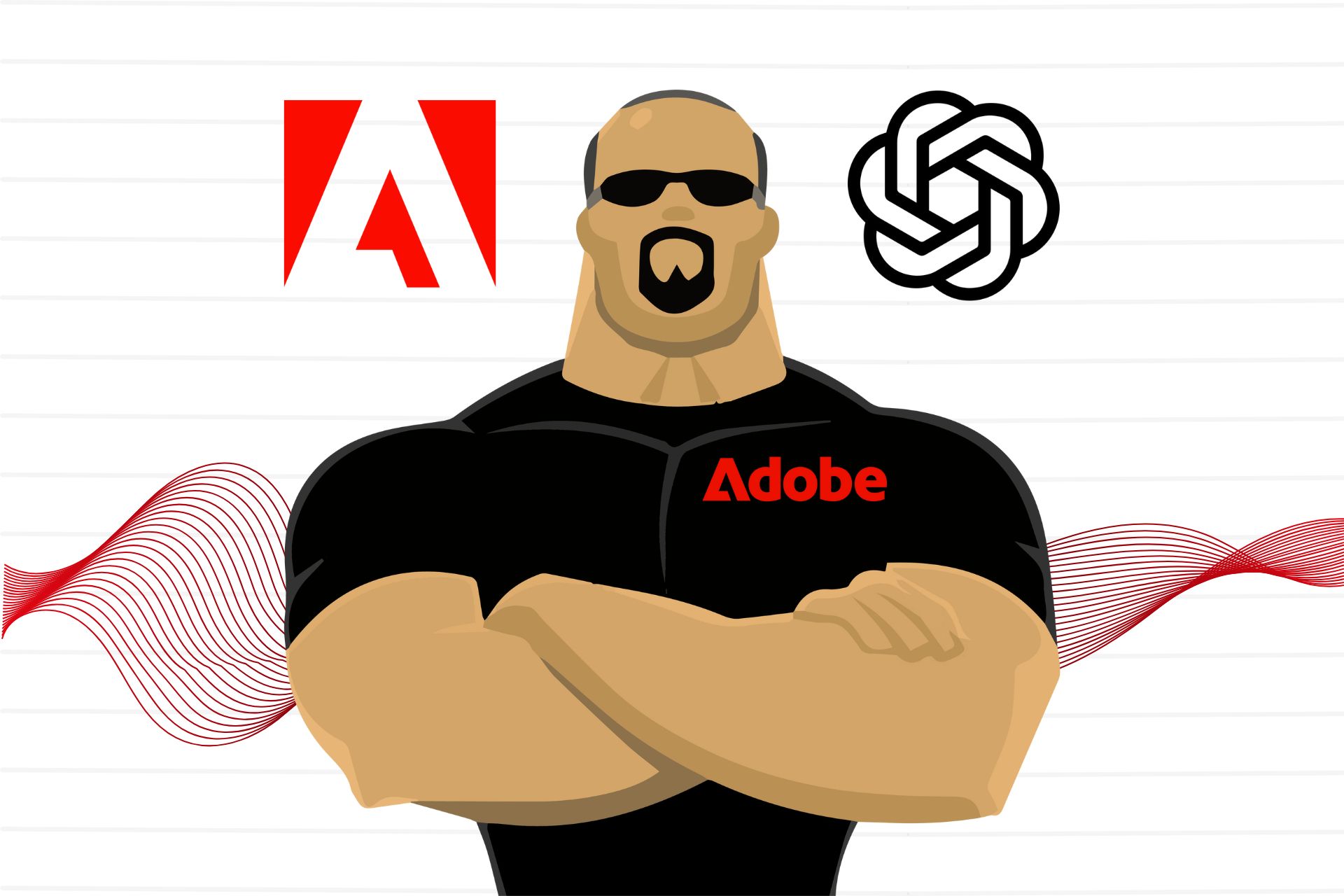
Adobe Tools integration with ChatGPT has stirred up the entire population. And why not!?
Some people saw it as just another impressive AI feature for everyday work. Others thought that it meant that designers will be losing their jobs, or that complicated creative works are getting simplified to just a few text prompts. Both kinds of reactions are not correct.
This Adobe ChatGPT integration is hardly a revolution in creativity, nor is it a dramatic automation story.
It is about something much quieter and more down-to-earth: everyday work, especially tasks for people who don’t want to become experts in yet another piece of software just to be able to do small things, thus the removal of friction.
This is the reason why this step is important, not only to designers but to business owners, operators, and anyone who uses technology to make work easier.
What Changes Does Adobe ChatGPT Integration bring?
To put it simply, Adobe has allowed parts of Photoshop, Adobe Express, and Acrobat to be accessed directly from ChatGPT. An individual can upload an image or a PDF, explain in his/her own words what he/she wants and get a result without an adobe application being separately opened.
Easy image editing, fast visual adjustments, simple document cleaning – all done in a conversational interface. Thats what you get with Adobe Photoshop ChatGPT.
But don’t think it’s a full Photoshop experience living inside ChatGPT. It is not Adobe giving up on its professional tools. Nor is it a shortcut to expert-level creative work. Adobe did not substitute its software with another one.
Instead, we can say it just madee accessing easier for people. The difference between the two integration points explains why the integration is comfortable to use without being disruptive.
Why Did Adobe Choose to Integrate With ChatGPT?
The official reason is more tied to accessibility and innovation. But the timing and reason is not fully explained. The more reasonable explanation would be that most users only see a small portion of what Adobe tools are capable of.
Photoshop and Acrobat are extremely powerful, but they are tools designed for experts. For the business users, this power is often accompanied by obstacles. The steepness of the learning curve slows down the processes.
The heaviness of the interfaces becomes more apparent. What should be a small task turns out to be much bigger than it should have been. Eventually, this led to the development of a pattern in most companies:
- The tools are mastered only by a small group
- Most people avoided it until absolute necessity
- This, in turn, meant delays, handoffs, and unnecessary dependencies for the non-complex work that was still there.
In simple terms, Adobe,s integration with ChatGPT has changed the way one accesses the tools. Rather than learning from menus, users provide descriptions. Instead of changing tools, they are staying with one. Adobe did not make its products less complex.
What they did was make the experience of using them less complex.
How Are Businesses Using Adobe Inside ChatGPT?
This partnership’s worth isn’t prominent in border situations. It is visible in typical daily moments. A founder, working late at night, is revising a pitch deck and has to rapidly fix an image before distributing it.
The sales employees are combining PDFs and doing mild editing on them to quickly send proposals to a client. A marketer resizes or adjusts the visuals for various platforms without the need to open a design tool she seldom uses.
None of these is an advanced creative task. However, they still consume time, require focus, and involve changing context. By having Adobe inside ChatGPT, these jobs become more accessible to finishing. Not perfectly, but they are done.
This work is not about raising the upper limit of what is possible. It is about lowering the amount of work necessary to complete routine tasks that would otherwise slow down people.
Who Benefits the Most from Adobe and ChatGPT Integration?
It is quite essential to delineate the major beneficiaries here. The integration performs optimally for:
- business owners who undertake sporadic creative or documentaire work
- teams that are in need of swift, good enough results
- persons who prioritize speed and ease rather than having precise control
For the users, the interaction becomes less heavy. A lesser number of tools. Less uncertainty. Less dependence on someone else for minor interventions.
It is less efficient for:
- design professionals engaged in intricate, iterative work
- teams that rely heavily on accurate layouts and advanced controls
- individuals who hold an expectation that ChatGPT can substitute creative judgment
Such users will keep working in traditional Adobe applications, and that is precisely where they ought to be. This integration is not about providing equal service to everyone. It is about catering to the majority who were never quite comfortable with complicated tools in the first place.
Why This Adobe ChatGPT Move Matters Outside of the Design World?
Looking at it from a distance, this decision conveys a very significant message regarding the future of software. For quite a few years products were competing with each other by simply adding more features.
Power was the thing that differentiated, and users were expected to adapt. The whole thing is changing now. Currently, the interface is just as important as the capability. People want to say what they want and then move on.
They do not want to learn systems they want results. ChatGPT is turning into a sort of auniversal working platform. Adobe saw that and decided to meet users there rather than taking them back to the old ways of working.
This is not only an AI feature. It is a decision related to the distribution and usability. And this is the decision that other software companies are almost certainly considering as well.
What Are the Limitations of Using Adobe Through ChatGPT?
There are certain compromises with this method, and it s worth being clear about them. Operating AI as the interface entails relinquishing some degree of control. Therefore, the decisions are made for you.
This is good when speed is required but not when accuracy is important. The advanced workflows are there in the traditional applications, rather than in ChatGPT. Eventually, users will reach the boundary and be required to switch to the full tools. There is also the potential for over-simplification.
Easy tools can facilitate the taking of shortcuts, even when there is a need for nuance. However, these compromises are not concealed. They are an integral part of the choice between convenience and control.
As long as the businesses are aware of that balance, the integration is performing the function it was intended for.
How Does This Change Day-to-Day Work for Teams?
For most teams, the impact won’t feel dramatic. It will feel subtle.
- Fewer emails asking for small edits.
- Less waiting for quick fixes.
- Fewer tools open at once.
Small tasks stop blocking progress. That may not sound exciting, but it’s meaningful, especially in businesses where momentum matters more than perfection.
This is AI doing its most useful job: removing friction rather than replacing people.
Does This Signal the Future of How Software Will Be Used?
Looking ahead, this integration points toward a broader shift. AI is becoming the front door to software. Complexity is moving behind the scenes. Users interact with intent, not interfaces. Traditional tools won’t disappear. But fewer people will need to touch them directly.
Adobe’s move suggests it understands this future and is positioning itself accordingly.
What Should Business Owners Take Away From Adobe’s ChatGPT Integration?
This integration isn’t about turning everyone into a designer. It’s about making it easier to finish work. Adobe didn’t make its tools less powerful. It made them easier to reach. For many businesses, that’s more valuable than adding another advanced feature.
In that sense, Adobe’s integration with ChatGPT isn’t about chasing AI trends. It’s about aligning software with how people actually work.